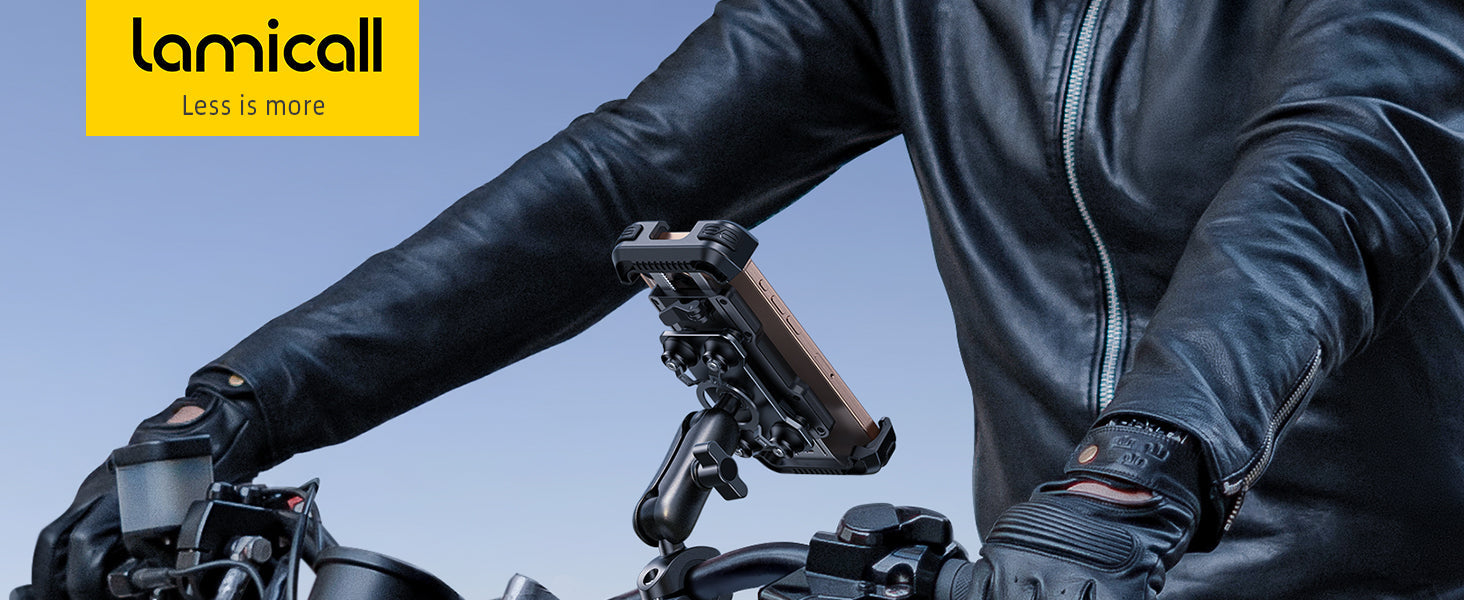

Hitting a pothole on a bike is uncomfortable enough. The last thing you want is to look down and realize your phone has shifted, or worse, fallen out of its mount.
Potholes, broken pavement, curbs, and other sudden impacts can send strong shocks through your handlebars. If your bike phone mount isn't installed correctly or doesn't provide enough grip, repeated bumps can cause the phone or the mount itself to move.
So, how do you keep your phone secure when riding on rough city streets?
The answer starts with choosing the right phone mount and making sure every part of the setup is properly secured.
Why Can Potholes Cause a Phone Mount to Move?
A bike phone mount has to deal with two different forces while you ride.
The first is continuous vibration from the road. Even relatively smooth pavement produces small vibrations that travel through the wheels, frame, and handlebars.
The second is sudden impact. When your front wheel hits a pothole, raised pavement, curb, or rough patch, the mount can experience a much stronger jolt.
Over time, these forces may cause a poorly fitted mount to rotate around the handlebar, loosen at an adjustment point, or allow the phone to shift inside the holder.
This is why a secure bike phone mount needs to do more than simply hold a phone while the bike is stationary.
1. Choose a Bike Phone Mount With a Secure Locking System
One of the first things to look at is how the phone is actually held in place.
Simple holders that rely mainly on friction may work for casual riding on smooth roads, but rough pavement demands a more secure retention system.
Look for features such as:
- A mechanical locking mechanism
- Firm side clamps
- Silicone or rubber contact areas
- A secure handlebar clamp
- A locking mechanism that is difficult to release accidentally
A four-corner design can be particularly useful because the phone is supported from multiple directions instead of relying only on pressure from two sides.
The goal isn't simply to make the grip as tight as possible. A good system should keep the phone securely positioned without damaging the device.
A well-designed phone holder should provide stable contact and reliable support around the phone. Whether it uses a partial-enclosure or four-corner design, the key is that the phone fits properly, stays firmly secured, and does not shift easily when riding over bumps or uneven roads.
2. Make Sure the Mount Fits Your Handlebar
Even a well-designed phone holder can become unstable if the handlebar clamp doesn't fit properly.
Before installing a mount, check your bike's handlebar diameter and compare it with the manufacturer's compatibility range.
For example, many Lamicall bike phone mounts are designed for handlebars between 0.59 and 1.57 inches (15–40 mm) in diameter.

A mount that is too large for the handlebar may rotate when you hit a pothole. A mount that is forced onto a handlebar outside its supported range may also fail to clamp correctly.
After installation, try twisting the mount firmly by hand.
If the entire mount rotates easily around the handlebar, it should be adjusted before riding.
3. Check Your Phone and Case Size
Handlebar compatibility is only half of the equation.
Your phone including its case also needs to fit securely inside the holder.
A thick protective case can significantly increase the overall width and thickness of a phone. Even if the bare phone is listed as compatible, the combination may exceed the holder's supported dimensions.
Before riding, check that:
- The phone sits completely inside the holder.
- All intended contact points are engaged.
- The case isn't preventing the holder from closing or locking properly.
- The phone doesn't move when you gently shake the mount by hand.
If you're using a particularly thick case, always check the mount's maximum supported phone thickness.
4. Pay Attention to Vibration Dampening

Keeping your phone from falling out and reducing vibration are related, but they aren't exactly the same thing.
Phone retention is about keeping the device physically secured inside the holder.
Vibration dampening is about reducing some of the vibration transferred from the road and bike to the mounted phone.
On rough pavement, gravel, and roads with frequent potholes, a mount with cushioning or a dedicated damping structure can help create a steadier platform for your phone.
Silicone contact pads can help reduce slipping and cushion contact between the phone and holder, while more advanced designs may use separate damping structures between the phone cradle and the rest of the mount.
However, vibration damping should never replace a secure locking system. Ideally, a bike phone mount should address both stability and retention.
5. Tighten Every Adjustment Point Before Riding
Sometimes the phone holder isn't the actual problem.
The connection between the holder and handlebar may be secure, but an adjustable joint has gradually loosened.
Before riding on rough roads, check:
- Handlebar clamp
- Rotation joint
- Angle adjustment mechanism
- Phone locking mechanism
- Screws or adjustment knobs
Once you've positioned the phone at your preferred viewing angle, make sure every adjustable part is properly tightened.
It's also worth checking the mount periodically, especially if you regularly ride on rough roads.
6. Test the Mount Before Your First Rough Ride
Don't wait until you hit a pothole at speed to discover that your phone mount isn't secure.
After installation, perform a simple test.
Place your phone in the mount, lock it completely, and firmly shake the handlebars from side to side. Gently pull the phone in different directions to check whether it can move out of the holder.
You can then take a short ride at low speed over normal pavement before moving onto rougher roads.
If the mount rotates, rattles, or the phone noticeably shifts, stop and readjust it.
7. Avoid Mounting the Phone at an Extreme Angle
A highly adjustable mount is useful, but that doesn't mean every possible position is equally suitable for rough roads.
Position your phone so that you can see navigation information without creating an unnecessarily long or awkward position away from the handlebar.
A compact mounting position can help reduce unwanted movement and also keeps the phone from interfering with brake cables, shifters, displays, or other handlebar accessories.
Always make sure the mount doesn't affect normal bike operation.
What Should You Look for in a Bike Phone Mount for Potholes?
If you frequently ride through cities with broken pavement or uneven roads, prioritize security over convenience alone.
A bike phone mount for bumpy roads should ideally provide a combination of:
Secure phone retention: The phone should remain firmly held inside the holder during everyday bumps and vibrations.
Strong handlebar grip: The entire mount shouldn't rotate easily when the bike hits uneven pavement.
Stable phone support: Whether the holder uses side clamping, partial-enclosure support, four-corner support, or another secure design, it should keep the phone stable during the ride.
Shock-absorbing materials: Silicone padding can reduce slipping and cushion contact between the phone and holder.
Reliable adjustment joints: Adjustable parts should stay in position once tightened.
Proper compatibility: Both your phone and handlebar need to fall within the mount's specified size range.
These details matter much more on rough roads than they might during a short ride on smooth pavement.
Can a Bike Phone Mount Really Handle Potholes?
A properly installed, compatible bike phone mount can provide secure phone retention during normal riding over uneven pavement and everyday road bumps. However, no phone mount can guarantee that a device will remain secure under every possible impact.
Large potholes can also create a safety risk for the rider, wheels, tires, and bike itself.
Whenever possible, reduce your speed and safely avoid severe potholes rather than relying on your phone mount—or any other bike component—to absorb the impact.
A More Secure Setup for Bumpy Roads
If rough pavement is part of your regular commute, think about the complete mounting system rather than focusing on a single feature.
The phone needs to fit the holder correctly. The locking mechanism needs to be fully engaged. The handlebar clamp needs to match your bike. Adjustment points need to stay tight. And cushioning or vibration-damping features can help manage repeated road vibration.
Before every long ride, a quick check only takes a few seconds:
Phone locked. Clamp secure. Joints tight.
That simple routine can make a big difference when the road ahead isn't perfectly smooth.